Businesses

CFPB Says Buy Now, Pay Later Firms Must Comply With US Credit Card Laws (cnbc.com) 14

The Consumer Financial Protection Bureau declared on Wednesday that customers of the burgeoning buy now, pay later industry have the same federal protections as users of credit cards. From a report: The agency unveiled what it called an "interpretive rule" that deemed BNPL lenders essentially the same as traditional credit card providers under the decades-old Truth in Lending Act. That means the industry -- currently dominated by fintech firms like Affirm, Klarna and PayPal -- must make refunds for returned products or canceled services, must investigate merchant disputes and pause payments during those probes, and must provide bills with fee disclosures.

"Regardless of whether a shopper swipes a credit card or uses Buy Now, Pay Later, they are entitled to important consumer protections under long-standing laws and regulations already on the books," CFPB Director Rohit Chopra said in a release. The CFPB, which last week was handed a crucial victory by the Supreme Court, has pushed hard against the U.S. financial industry, issuing rules that slashed credit card late fees and overdraft penalties. The agency, formed in the aftermath of the 2008 financial crisis, began investigating the BNPL industry in late 2021.

Encryption

Undisclosed WhatsApp Vulnerability Lets Governments See Who You Message (theintercept.com) 38

WhatsApp's security team warned that despite the app's encryption, users are vulnerable to government surveillance through traffic analysis, according to an internal threat assessment obtained by The Intercept. The document suggests that governments can monitor when and where encrypted communications occur, potentially allowing powerful inferences about who is conversing with whom. The report adds: Even though the contents of WhatsApp communications are unreadable, the assessment shows how governments can use their access to internet infrastructure to monitor when and where encrypted communications are occurring, like observing a mail carrier ferrying a sealed envelope. This view into national internet traffic is enough to make powerful inferences about which individuals are conversing with each other, even if the subjects of their conversations remain a mystery. "Even assuming WhatsApp's encryption is unbreakable," the assessment reads, "ongoing 'collect and correlate' attacks would still break our intended privacy model."

The WhatsApp threat assessment does not describe specific instances in which it knows this method has been deployed by state actors. But it cites extensive reporting by the New York Times and Amnesty International showing how countries around the world spy on dissident encrypted chat app usage, including WhatsApp, using the very same techniques. As war has grown increasingly computerized, metadata -- information about the who, when, and where of conversations -- has come to hold immense value to intelligence, military, and police agencies around the world. "We kill people based on metadata," former National Security Agency chief Michael Hayden once infamously quipped.
Meta said "WhatsApp has no backdoors and we have no evidence of vulnerabilities in how WhatsApp works." Though the assessment describes the "vulnerabilities" as "ongoing," and specifically mentions WhatsApp 17 times, a Meta spokesperson said the document is "not a reflection of a vulnerability in WhatsApp," only "theoretical," and not unique to WhatsApp.
Earth

'Never-Ending' UK Rain Made 10 Times More Likely By Climate Crisis, Study Says (theguardian.com) 154

The seemingly "never-ending" rain last autumn and winter in the UK and Ireland was made 10 times more likely and 20% wetter by human-caused global heating, a study has found. From a report: More than a dozen storms battered the region in quick succession between October and March, which was the second-wettest such period in nearly two centuries of records. The downpour led to severe floods, at least 20 deaths, severe damage to homes and infrastructure, power blackouts, travel cancellations, and heavy losses of crops and livestock.

The level of rain caused by the storms would have occurred just once in 50 years without the climate crisis, but is now expected every five years owing to 1.2C of global heating reached in recent years. If fossil fuel burning is not rapidly cut and the global temperature reaches 2C in the next decade or two, such severe wet weather would occur every three years on average, the analysis showed. [...] The analysis, conducted by climate scientists working as part of the World Weather Attribution group, compared how likely and how intense the wet winter was in today's heated world with how likely it would have been in a world without high levels of carbon emissions. Warmer air can hold more water vapour and therefore produce more rain. Hundreds of "attribution studies" have shown how global heating is already supercharging extreme weather such as heatwaves, wildfires, droughts and storms across the world.

Windows

Windows XP Can Run On an Intel CPU From 1989 Thanks To Dedicated Modder (techspot.com) 58

An anonymous reader shares a report: For those of us who came of age in the early days of personal computing, the names "Intel 486" and "Windows XP" evoke a nostalgic whirlwind of memories. The 486 was the hot new CPU of the early 90s, while Windows XP became a household name and Microsoft's most popular OS over a decade later. But did you ever imagine these two icons of different eras could be merged into an unholy union? Well, start brushing off those vintage 486 rigs, because a modder has actually made it happen. Going by the name Dietmar on the MSFN forums, he has somehow managed to get Microsoft's beloved Windows XP running on the ancient 486 architecture.

It's worth mentioning that these two were never meant to coexist. The first 486 chips hit the market way back in 1989, while Windows XP landed over a decade later in 2001. The 486 represented a major breakthrough when Intel unveiled it in 1989. Packing over a million transistors, it remained Intel's primary x86 chip until the arrival of the Pentium in 1993. Such was the processor's longevity that Intel continued manufacturing it for embedded systems until 2007. Still, 486 systems were simply too underpowered to run XP, which needed at least a Pentium-class processor from the 586 generation - or any compatible chip that ran at 233MHz or higher. Meanwhile, the i486 could only do 133MHz. It also needed at least 64MB of RAM and at least 1.5GB of storage.

Space

Russia Likely Launched Counter Space Weapon Into Low Earth Orbit Last Week, Pentagon Says (go.com) 70

The United States has assessed that Russia launched what is likely a counter space weapon last week that's now in the same orbit as a U.S. government satellite, Pentagon spokesman Maj. Gen. Pat Ryder confirmed Tuesday. From a report: "What I'm tracking here is on May 16, as you highlighted, Russia launched a satellite into low Earth orbit that we that we assess is likely a counter space weapon presumably capable of attacking other satellites in low Earth orbit," Ryder said when questioned by ABC News about the information, which was made public earlier Tuesday by Robert Wood, deputy U.S. ambassador to the United Nations.

"Russia deployed this new counter space weapon into the same orbit as a U.S. government satellite," Ryder continued. "And so assessments further indicate characteristics resembling previously deployed counter space payloads from 2019 and 2022." Ryder added: "Obviously, that's something that we'll continue to monitor. Certainly, we would say that we have a responsibility to be ready to protect and defend the space domain and ensure continuous and uninterrupted support to the joint and combined force. And we'll continue to balance the need to protect our interests in space with our desire to preserve a stable and sustainable space environment." When asked if the Russian counter space weapon posed a threat to the U.S. satellite, Ryder responded: "Well, it's a counter space weapon in the same orbit as a U.S. government satellite."

AI

Amazon Plans To Give Alexa an AI Overhaul - and a Monthly Subscription Price (cnbc.com) 36

Amazon is upgrading its decade-old Alexa voice assistant with generative AI and plans to charge a monthly subscription fee to offset the cost of the technology, CNBC reported Wednesday, citing people with knowledge of Amazon's plans. From the report: The Seattle-based tech and retail giant will launch a more conversational version of Alexa later this year, potentially positioning it to better compete with new generative AI-powered chatbots from companies including Google and OpenAI, according to two sources familiar with the matter, who asked not to be named because the discussions were private. Amazon's subscription for Alexa will not be included in the $139-per-year Prime offering, and Amazon has not yet nailed down the price point, one source said.

While Amazon wowed consumers with Alexa's voice-driven tasks in 2014, its capabilities could seem old-fashioned amid recent leaps in artificial intelligence. Last week, OpenAI announced GPT-4o, with the capability for two-way conversations that can go significantly deeper than Alexa. For example, it can translate conversations into different languages in real time. Google launched a similar generative-AI-powered voice feature for Gemini.

United States

US Securities Regulator Urges Against Crypto Bill Adoption 39

The U.S. securities regulator on Wednesday urged U.S. lawmakers not to adopt a bill that aims to create a new legal framework for digital currencies, saying it would undermine existing legal precedent and put capital markets at "immeasurable risk." From a report: The U.S. House of Representatives is expected later on Wednesday to take up the Republican-sponsored Financial Innovation and Technology for the 21st Century Act, which would in part determine which agencies have jurisdiction over which digital assets. The bill's supporters in Congress say it will provide regulatory clarity, helping promote the industry's growth.

The legislation faces an uncertain fate in the U.S. Senate but comes as the U.S. Securities and Exchange Commission (SEC) signals that it will likely approve applications for spot ether exchange-trade funds in a surprising boost to the industry. But SEC Chair Gary Gensler said in a statement that the bill "would create new regulatory gaps and undermine decades of precedent regarding the oversight of investment contracts, putting investors and capital markets at immeasurable risk."
AI

Wearable AI Startup Humane Explores Potential Sale 18

AI startup Humane has been seeking a buyer for its business, Bloomberg News reported, citing people familiar with the matter, just weeks after the company's closely watched wearable AI device had a rocky public launch. From the report: The company is working with a financial adviser to assist it, said the people, who asked not to be identified because the matter is private. Humane is seeking a price of between $750 million and $1 billion in a sale [non-paywalled link], one person said. The process is still early and may not result in a deal. Humane was founded in 2018 by two longtime Apple veterans, the married couple Imran Chaudhri and Bethany Bongiorno, in an attempt to come up with a new, AI-powered device that could potentially rival the iPhone. Last year it was valued by investors at $850 million, according to tech news site the Information.
AI

Meta AI Chief Says Large Language Models Will Not Reach Human Intelligence (ft.com) 78

Meta's AI chief said the large language models that power generative AI products such as ChatGPT would never achieve the ability to reason and plan like humans, as he focused instead on a radical alternative approach to create "superintelligence" in machines. From a report: Yann LeCun, chief AI scientist at the social media giant that owns Facebook and Instagram, said LLMs had "very limited understanding of logicâ... do not understand the physical world, do not have persistent memory, cannot reason in any reasonable definition of the term and cannot planâ...âhierarchically."

In an interview with the Financial Times, he argued against relying on advancing LLMs in the quest to make human-level intelligence, as these models can only answer prompts accurately if they have been fed the right training data and are, therefore, "intrinsically unsafe." Instead, he is working to develop an entirely new generation of AI systems that he hopes will power machines with human-level intelligence, although he said this vision could take 10 years to achieve. Meta has been pouring billions of dollars into developing its own LLMs as generative AI has exploded, aiming to catch up with rival tech groups, including Microsoft-backed OpenAI and Alphabet's Google.

China

ASML and TSMC Can Disable Chip Machines If China Invades Taiwan (yahoo.com) 135

An anonymous reader quotes a report from Bloomberg: ASML Holding NV and Taiwan Semiconductor Manufacturing Co. have ways to disable the world's most sophisticated chipmaking machines in the event that China invades Taiwan, according to people familiar with the matter. Officials from the US government have privately expressed concerns to both their Dutch and Taiwanese counterparts about what happens if Chinese aggression escalates into an attack on the island responsible for producing the vast majority of the world's advanced semiconductors, two of the people said, speaking on condition of anonymity. ASML reassured officials about its ability to remotely disable the machines when the Dutch government met with the company on the threat, two others said. The Netherlands has run simulations on a possible invasion in order to better assess the risks, they added.

The remote shut-off applies to Netherlands-based ASML's line of extreme ultraviolet machines, known within the industry as EUVs, for which TSMC is its single biggest client. EUVs harness high-frequency light waves to print the smallest microchip transistors in existence -- creating chips that have artificial-intelligence uses as well as more sensitive military applications. About the size of a city bus, an EUV requires regular servicing and updates. As part of that, the company can remotely force a shut-off which would act as a kill switch, the people said, speaking on condition of anonymity. The Veldhoven-based company is the world's only manufacturer of these machines, which sell for more than $217 million apiece.

Android

Google Brings Back Group Speaker Controls After Sonos Lawsuit Win (arstechnica.com) 16

Android Authority's Mishaal Rahman reports that the group speaker volume controls feature is back in Android 15 Beta 2. "Google intentionally disabled this functionality on Pixel phones back in late 2021 due to a legal dispute with Sonos," reports Rahman. "In late 2023, Google announced it would bring back several features they had to remove, following a judge's overturning of a jury verdict that was in favor of Sonos." From the report: When you create a speaker group consisting of one or more Assistant-enabled devices in the Google Home app, you're able to cast audio to that group from your phone using a Cast-enabled app. For example, let's say I make a speaker group named "Nest Hubs" that consists of my bedroom Nest Hub and my living room Nest Hub. If I open the YouTube Music app, start playing a song, and then tap the cast icon, I can select "Nest Hubs" to start playback on both my Nest Hubs simultaneously.

If I keep the YouTube Music app open, I can control the volume of my speaker group by pressing the volume keys on my phone. This functionality is available no matter what device I use. However, if I open another app while YouTube Music is casting, whether I'm able to still control the volume of my speaker group using my phone's volume keys depends on what phone I'm using and what software version it's running. If I'm using a Pixel phone that's running a software version before Android 15 Beta 2, then I'm unable to control the volume of my speaker group unless I re-open the YouTube Music app. If I'm using a phone from any other manufacturer, then I won't have any issues controlling the volume of my speaker group.

The reason for this weird discrepancy is that Google intentionally blocked Pixel devices from being able to control the volume of Google Home speaker groups while casting. Google did this out of an abundance of caution while they were fighting a legal dispute. [...] With the release of last week's Android 15 Beta 2, we can confirm that Google finally restored this functionality.

Transportation

EVs More Likely To Hit Pedestrians Than Petrol Vehicles, Study Finds (theguardian.com) 287

Hybrid and electric cars are more likely to hit pedestrians than petrol or diesel vehicles, due to their quieter engines that make them harder for pedestrians to hear. Other contributing factors include the tendency for drivers of electric cars to be younger and less experienced, and the vehicles' heavier weight and swift acceleration, increasing stopping distances. The Guardian reports: Data from 32 billion miles of battery-powered car travel and 3 trillion miles of petrol and diesel car trips showed that mile-for-mile electric and hybrid cars were twice as likely to hit pedestrians than fossil fuel-powered cars, and three times more likely to do so in urban areas. "Electric cars are a hazard to pedestrians because they are less likely to be heard than petrol or diesel cars," said Phil Edwards, first author on the study and professor of epidemiology and statistics at the London School of Hygiene & Tropical Medicine. "The government needs to mitigate these risks if they are going to phase out the sale of petrol and diesel cars." "If you're moving to an electric car, remember it's a new kind of vehicle," Edwards added. "They are much quieter than the old-fashioned cars, and pedestrians have learned to navigate roads by listening for traffic. Drivers of these vehicles need to be extra cautious."

Most vehicles on the road are petrol or diesel and these were involved in three-quarters of pedestrian collisions. But for the same distance travelled, battery-powered cars were more dangerous. The average annual pedestrian casualty rate per 100m miles travelled was 5.16 for electric and hybrid cars compared with 2.4 for petrol and diesel cars, according to the study in the Journal of Epidemiology and Community Health. In rural settings, battery-powered cars were no more dangerous than petrol or diesel, but in towns and cities they were three times more likely to collide with pedestrians, the researchers found. Since July 2019, all new hybrid and electric vehicles sold in Europe have been required to have an acoustic vehicle alerting system that emits sound when the car is travelling slowly, but there are hundreds of thousands of electric cars on the road without the devices. "If government made sure these systems were installed in all electric vehicles and retrofitted them to older electric cars, that would be a good start," Edwards said, adding that the Green Cross Code also "probably needs updating."

Power

California Exceeds 100% of Energy Demand With Renewables Over a Record 45 Days (electrek.co) 155

An anonymous reader quotes a report from Electrek: In a major clean energy benchmark, wind, solar, and hydro exceeded 100% of demand on California's main grid for 69 of the past 75 days. Stanford University professor of civil and environmental engineering Mark Z. Jacobson continues to track California's renewables performance – and it's still exciting. In an update today on Twitter (X), Jacobson reports that California has now exceeded 100% of energy demand with renewables over a record 45 days straight, and 69 out of 75. [...]

Jacobson predicted on April 4 that California will entirely be on renewables and battery storage 24/7 by 2035. California passed a law that commits to achieving 100% net zero electricity by 2045. Will it beat that goal by a decade? We hope so. It's going to be exciting to watch.
Further reading: California Exceeds 100% of Energy Demand With Renewables Over a Record 30 Days
AI

DOJ Makes Its First Known Arrest For AI-Generated CSAM (engadget.com) 98

In what's believed to be the first case of its kind, the U.S. Department of Justice arrested a Wisconsin man last week for generating and distributing AI-generated child sexual abuse material (CSAM). Even if no children were used to create the material, the DOJ "looks to establish a judicial precedent that exploitative materials are still illegal," reports Engadget. From the report: The DOJ says 42-year-old software engineer Steven Anderegg of Holmen, WI, used a fork of the open-source AI image generator Stable Diffusion to make the images, which he then used to try to lure an underage boy into sexual situations. The latter will likely play a central role in the eventual trial for the four counts of "producing, distributing, and possessing obscene visual depictions of minors engaged in sexually explicit conduct and transferring obscene material to a minor under the age of 16." The government says Anderegg's images showed "nude or partially clothed minors lasciviously displaying or touching their genitals or engaging in sexual intercourse with men." The DOJ claims he used specific prompts, including negative prompts (extra guidance for the AI model, telling it what not to produce) to spur the generator into making the CSAM.

Cloud-based image generators like Midjourney and DALL-E 3 have safeguards against this type of activity, but Ars Technica reports that Anderegg allegedly used Stable Diffusion 1.5, a variant with fewer boundaries. Stability AI told the publication that fork was produced by Runway ML. According to the DOJ, Anderegg communicated online with the 15-year-old boy, describing how he used the AI model to create the images. The agency says the accused sent the teen direct messages on Instagram, including several AI images of "minors lasciviously displaying their genitals." To its credit, Instagram reported the images to the National Center for Missing and Exploited Children (NCMEC), which alerted law enforcement. Anderegg could face five to 70 years in prison if convicted on all four counts. He's currently in federal custody before a hearing scheduled for May 22.

EU

EU Sets Benchmark For Rest of the World With Landmark AI Laws (reuters.com) 28

An anonymous reader quotes a report from Reuters: Europe's landmark rules on artificial intelligence will enter into force next month after EU countries endorsed on Tuesday a political deal reached in December, setting a potential global benchmark for a technology used in business and everyday life. The European Union's AI Act is more comprehensive than the United States' light-touch voluntary compliance approach while China's approach aims to maintain social stability and state control. The vote by EU countries came two months after EU lawmakers backed the AI legislation drafted by the European Commission in 2021 after making a number of key changes. [...]

The AI Act imposes strict transparency obligations on high-risk AI systems while such requirements for general-purpose AI models will be lighter. It restricts governments' use of real-time biometric surveillance in public spaces to cases of certain crimes, prevention of terrorist attacks and searches for people suspected of the most serious crimes. The new legislation will have an impact beyond the 27-country bloc, said Patrick van Eecke at law firm Cooley. "The Act will have global reach. Companies outside the EU who use EU customer data in their AI platforms will need to comply. Other countries and regions are likely to use the AI Act as a blueprint, just as they did with the GDPR," he said, referring to EU privacy rules.

While the new legislation will apply in 2026, bans on the use of artificial intelligence in social scoring, predictive policing and untargeted scraping of facial images from the internet or CCTV footage will kick in in six months once the new regulation enters into force. Obligations for general purpose AI models will apply after 12 months and rules for AI systems embedded into regulated products in 36 months. Fines for violations range from $8.2 million or 1.5% of turnover to 35 million euros or 7% of global turnover depending on the type of violations.

Windows

Windows Now Has AI-Powered Copy and Paste 59

Umar Shakir reports via The Verge: Microsoft is adding a new Advanced Paste feature to PowerToys for Windows 11 that can convert your clipboard content on the fly with the power of AI. The new feature can help people speed up their workflows by doing things like copying code in one language and pasting it in another, although its best tricks require OpenAI API credits.

Advanced Paste is included in PowerToys version 0.81 and, once enabled, can be activated with a special key command: Windows Key + Shift + V. That opens an Advanced Paste text window that offers paste conversion options including plaintext, markdown, and JSON. If you enable Paste with AI in the Advanced Paste settings, you'll also see an OpenAI prompt where you can enter the conversion you want -- summarized text, translations, generated code, a rewrite from casual to professional style, Yoda syntax, or whatever you can think to ask for.
Science

'Pay Researchers To Spot Errors in Published Papers' 24

Borrowing the idea of "bug bounties" from the technology industry could provide a systematic way to detect and correct the errors that litter the scientific literature. Malte Elson, writing at Nature: Just as many industries devote hefty funding to incentivizing people to find and report bugs and glitches, so the science community should reward the detection and correction of errors in the scientific literature. In our industry, too, the costs of undetected errors are staggering. That's why I have joined with meta-scientist Ian Hussey at the University of Bern and psychologist Ruben Arslan at Leipzig University in Germany to pilot a bug-bounty programme for science, funded by the University of Bern. Our project, Estimating the Reliability and Robustness of Research (ERROR), pays specialists to check highly cited published papers, starting with the social and behavioural sciences (see go.nature.com/4bmlvkj). Our reviewers are paid a base rate of up to 1,000 Swiss francs (around US$1,100) for each paper they check, and a bonus for any errors they find. The bigger the error, the greater the reward -- up to a maximum of 2,500 francs.

Authors who let us scrutinize their papers are compensated, too: 250 francs to cover the work needed to prepare files or answer reviewer queries, and a bonus 250 francs if no errors (or only minor ones) are found in their work. ERROR launched in February and will run for at least four years. So far, we have sent out almost 60 invitations, and 13 sets of authors have agreed to have their papers assessed. One review has been completed, revealing minor errors. I hope that the project will demonstrate the value of systematic processes to detect errors in published research. I am convinced that such systems are needed, because current checks are insufficient. Unpaid peer reviewers are overburdened, and have little incentive to painstakingly examine survey responses, comb through lists of DNA sequences or cell lines, or go through computer code line by line. Mistakes frequently slip through. And researchers have little to gain personally from sifting through published papers looking for errors. There is no financial compensation for highlighting errors, and doing so can see people marked out as troublemakers.
Linux

Linux 6.10 Honors One Last Request By Hans Reiser (phoronix.com) 71

Longtime Slashdot reader DVega shares a report from Phoronix: ReiserFS lead developer and convicted murderer Hans Reiser a few months back wrote letters to be made public apologizing for his social mistakes and other commentary. In his written communications he also made a last request for ReiserFS in the Linux kernel: "Assuming that the decision is to remove [ReiserFS] V3 from the kernel, I have just one request: that for one last release the README be edited to add Mikhail Gilula, Konstantin Shvachko, and Anatoly Pinchuk to the credits, and to delete anything in there I might have said about why they were not credited. It is time to let go."

Hans credits his improved social and communication skills learned in prison among other details shared in the public letters. Per the indirect request by Hans Reiser, SUSE's Jan Kara has now altered the ReiserFS README file with the changes going in today to the Linux 6.10 kernel. The negative language was removed and instead acknowledging their contributions.

Microsoft

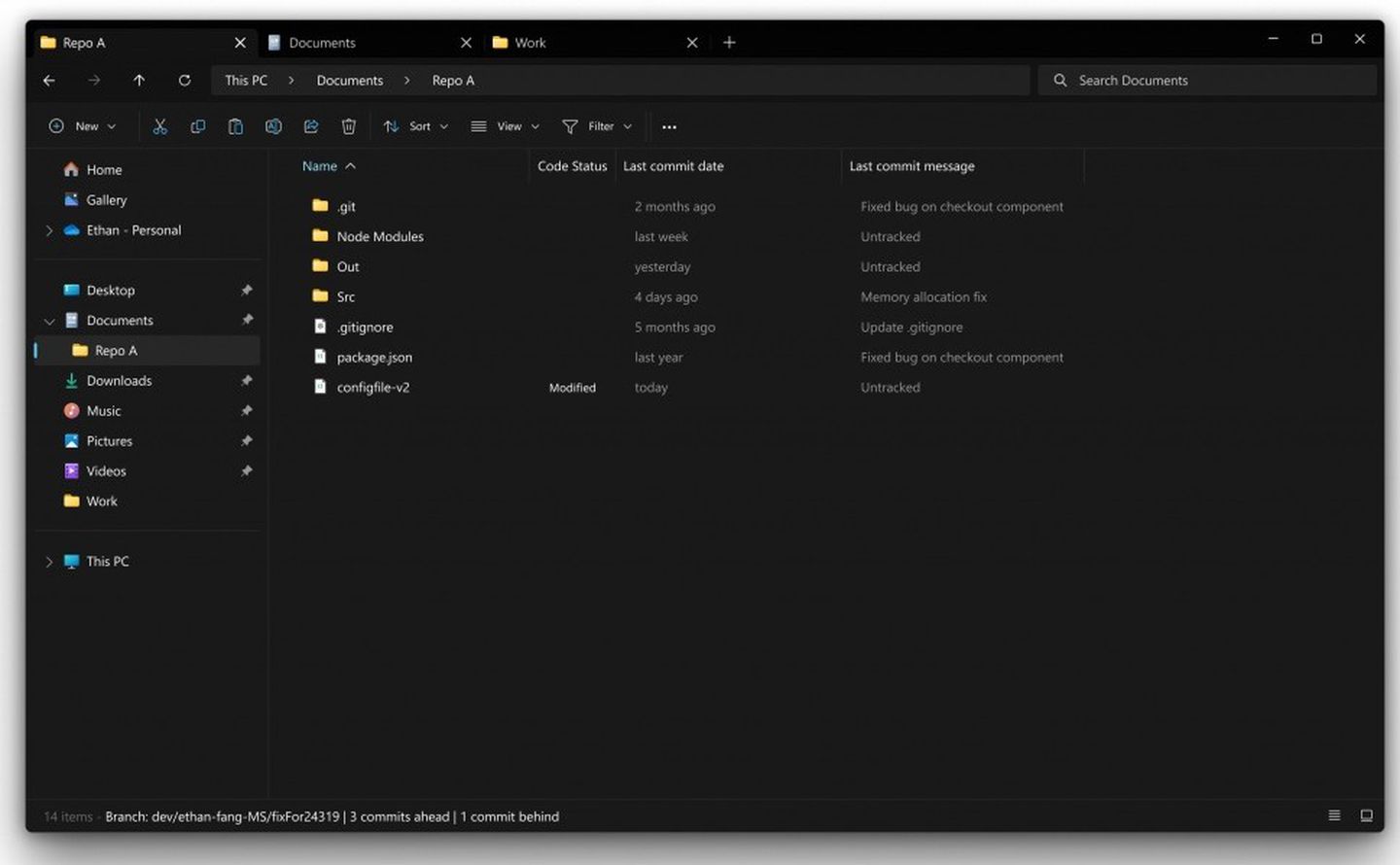
Microsoft Is Making File Explorer More Powerful With Version Control and 7z Compression (theverge.com) 44

Sean Hollister reports via The Verge: At Build, Microsoft now says it's adding native version control to File Explorer by integrating systems like Git, letting you see new changes and comments directly from the app. Here's a cropped and zoomed version of the provided screenshot so you can get a better look. [...] Microsoft says it's also letting File Explorer natively compress files to 7-zip and TAR; currently, the right-click context menu has a "Compress to ZIP file" option, but ZIP is thought to be a bit antiquated in terms of how much compression you get.
Businesses

IGN Scoops Up Eurogamer, Rock Paper Shotgun, and More (theverge.com) 9

It seems no industry is safe from consolidation, and the latest target is gaming media. From a report: IGN Entertainment has acquired the website portfolio of UK publisher Gamer Network, which operates a number of beloved games-focused publications. That list includes Gamesindustry.biz, Eurogamer, Rock Paper Shotgun, VG247, and the tabletop site Dicebreaker. The network also holds shares in sites like Nintendo Life and Digital Foundry.

Terms of the deal were not disclosed. Gamesindustry.biz reports that "some redundancies" have been made across the sites, though it's not clear how many workers have been impacted. According to several posts on X, editors at both Rock Paper Shotgun and Gamesindustry.biz have been laid off. IGN Entertainment is owned by Ziff Davis, which, in addition to IGN's site, also operates other subsidiaries like Humble Bundle.

Slashdot Top Deals