Firefox

Firefox 148 Now Available With The New AI Controls, AI Kill Switches 71

Firefox 148 introduces granular AI controls and a global "AI kill switch" that allows users to disable or selectively manage the browser's AI features. Phoronix reports: Among the AI features that can be toggled individually are around translations, image alt text in the Firefox PDF viewer, tab group suggestions, key points in link previews, and AI chatbot providers in the sidebar. Firefox 148 also brings Firefox for Android, support for the Trusted Types API, CSS shape() function support, Sanitizer API support, WebGPU enhancements, and a variety of other changes. Developer chances can be found at developer.mozilla.org. Binaries are available from ftp.mozilla.org.
United States

US Farmers Are Rejecting Multimillion-Dollar Datacenter Bids For Their Land (theguardian.com) 96

An anonymous reader quotes a report from the Guardian: When two men knocked on Ida Huddleston's door last May, they carried a contract worth more than $33m in exchange for the Kentucky farm that had fed her family for centuries. According to Huddleston, the men's client, an unnamed "Fortune 100 company," sought her 650 acres (260 hectares) in Mason county for an unspecified industrial development. Finding out any more would require signing a non-disclosure agreement. More than a dozen of her neighbors received the same knock. Searching public records for answers, they discovered that a new customer (PDF) had applied for a 2.2 gigawatt project from the local power plant, nearly double its annual generation capacity. The unknown company was building a datacenter. "You don't have enough to buy me out. I'm not for sale. Leave me alone, I'm satisfied," Huddleston, 82, later told the men.

As tech companies race to build the massive datacenters needed to power artificial intelligence across the US and the world, bids like the one for Huddleston's land are appearing on rural doorsteps nationwide. Globally, 40,000 acres of powered land – real estate prepped for datacenter development -- are projected to be needed for new projects over the next five years, double the amount currently in use. Yet despite sums that often dwarf the land's recent value, farmers are increasingly shutting the door. At least five of Huddleston's neighbors gave similar categorical rejections, including one who was told he could name any price.

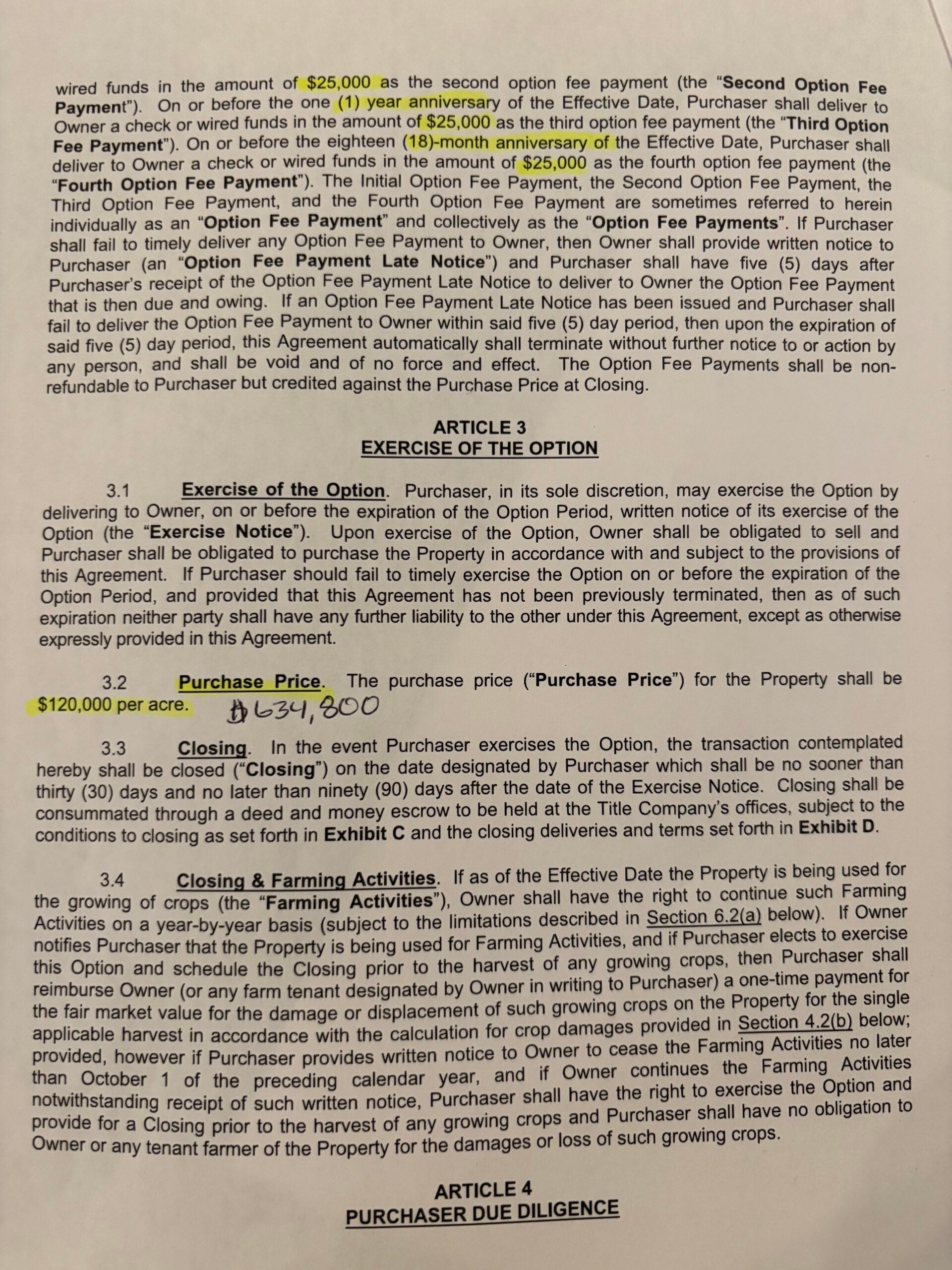
In Pennsylvania, a farmer rejected $15m in January for land he'd worked for 50 years. A Wisconsin farmer turned down $80m the same month. Other landowners have declined offers exceeding $120,000 per acre -- prices unimaginable just a few years ago. The rebuffs are a jarring reminder of AI's physical bounds, and limits of the dollars behind the technology. [...] As AI promises to transcend corporeal fallibility, these standoffs reveal its very physical constraints -- and Wall Street's miscalculation of what some people value most. In the rolling hills of Mason county and farmland across America, that gap is measured not in dollars but in something harder to price: identity.

XBox (Games)

New Microsoft Gaming CEO Has 'No Tolerance For Bad AI' (variety.com) 58

In her first major interview as Microsoft's new gaming chief, Asha Sharma said that "great games" must deliver emotional resonance and a distinct creative voice, while making clear that she has "no tolerance for bad AI." Stepping in after Phil Spencer's retirement, she's pledging consistency, community trust, and a human-first approach to storytelling as Xbox enters a new era. Variety reports: Sharma was quick in laying out her top priorities for Microsoft Gaming in an internal memo announcing her promotion, noting "great games," "the return of Xbox" and the "future of play" as her three main commitments to the gaming community. So first, what makes a great game for Sharma, whose roles prior to CoreAI include top positions at Instacart and Meta? The new Microsoft Gaming CEO tells Variety it's all about games with "deep emotional resonance" and "a distinct point of view." She wants to develop stories that make players "feel something," like the kind of feelings Campo Santo's 2016 first-person mystery "Firewatch" elicited in her.

Sharma takes on the mantle as head of the leading competitor to Sony's PlayStation and Nintendo knowing full well she's entering the role as an outsider to the larger gaming community and has "a lot to learn" still. But Sharma says she's got a commitment to "being grounded in what the community is telling us." "I'm coming into gaming as a platform builder," Sharma said, adding that her goal is to "earn the right to be trusted by players and developers" and show the fanbase that "consistency" over time. In her interview with Variety, Sharma acknowledged the tumultuous state of the gaming industry, referencing Matthew Ball's recent State of Video Gaming in 2026 report as evidence that the larger "transformation" of the sector is "protecting what we believe in while remaining open-minded about the future."

Due to her strong background in AI, initial reactions to Sharma's appointment have raised concerns about what her specific views are on the use of generative AI in game development. Sharma says her stance is simple: she has "no tolerance for bad AI." "AI has long been part of gaming and will continue to be," Sharma said, noting that gaming needs new "growth engines," but that "great stories are created by humans."

AI

Viral Doomsday Report Lays Bare Wall Street's Deep Anxiety About AI Future 52

A 7,000-word "doomsday" thought experiment from Citrini Research helped trigger an 800-point drop in the Dow, "painting a dark portrait of a future in which technological change inspires a race to the bottom in white-collar knowledge work," reports the Wall Street Journal. From the report: Concerns of hyperscalers overspending are out. Worries of software-industry disruption don't go far enough. The "global intelligence crisis" is about to hit. The new, broader question: What if AI is so bullish for the economy that it is actually bearish? "For the entirety of modern economic history, human intelligence has been the scarce input," Citrini wrote in a post it described as a scenario dated June 2028, not a prediction. "We are now experiencing the unwind of that premium."

Many of Monday's moves roughly aligned with the situation outlined by Citrini, in which fast-advancing AI tools allow spending cuts across industries, sparking mass white-collar unemployment and in turn leading to financial contagion. Software firms DataDog, CrowdStrike and Zscaler each plunged more than 9%. International Business Machines' 13% decline was its worst one-day performance since 2000. American Express, KKR and Blackstone -- all name-checked by Citrini -- tumbled. That anxiety, coupled with renewed uncertainty about trade policy from Washington, weighed down major indexes Monday. The Dow Jones Industrial Average led declines, falling 1.7%, or 822 points. The S&P 500 shed 1%, while the Nasdaq composite retreated 1.1%.

[...] Monday's market swings extended a run of AI-linked volatility. A small research outfit that has garnered a huge Substack following for macro and thematic stock research, Citrini said in its new post that software firms, payment processors and other companies formed "one long daisy chain of correlated bets on white-collar productivity growth" that AI is poised to disrupt. [...] Shares in DoorDash also veered 6.6% lower Monday after Citrini's Substack note called the delivery app a "poster child" for how new tools would upend companies that monetize interpersonal friction. In the research firm's scenario, AI agents would help both drivers and customers navigate food deliveries at much lower costs.
Businesses

OpenAI Calls In the Consultants For Its Enterprise Push (techcrunch.com) 14

OpenAI has formed a multi-year "Frontier Alliance" with four consulting heavyweights to accelerate enterprise adoption of its no-code AI agent platform, OpenAI Frontier. TechCrunch reports: The alliance includes multi-year partnerships between OpenAI and four major consulting firms, Boston Consulting Group (BCG), McKinsey, Accenture and Capgemini, to sell its enterprise products. OpenAI's Forward Deployed Engineering team will work with the consulting giants to help them implement OpenAI's enterprise-focused technologies like OpenAI Frontier into customers' tech stacks.

The company launched OpenAI Frontier in early February. The no-code open software allows users to build, deploy, and manage AI agents both built on OpenAI's AI models and beyond. OpenAI argues in its latest announcement that consultants are the right avenue to get enterprises on board.

"AI alone does not drive transformation. It must be linked to strategy, built into redesigned processes, and adopted at scale with aligned incentives and culture to deliver sustained outcomes," BCG CEO Christoph Schweizer said in OpenAI's blog post. "Our expanded partnership combines OpenAI's Frontier platform with BCG's deep industry, functional, and tech expertise and BCG X's build-and-scale capabilities to drive measurable impact with safeguards from day one."

IBM

IBM Shares Crater 13% After Anthropic Says Claude Code Can Tackle COBOL Modernization (cnbc.com) 113

IBM shares plunged nearly 13% on Monday after Anthropic published a blog post arguing that its Claude Code tool could automate much of the complex analysis work involved in modernizing COBOL, the decades-old programming language that still underpins an estimated 95% of ATM transactions in the United States and runs on the kind of mainframe systems IBM has sold for generations.

Anthropic said the shrinking pool of developers who understand COBOL had long made modernization cost-prohibitive, and that AI could now flip that equation by mapping dependencies and documenting workflows across thousands of lines of legacy code. The sell-off deepened a rough 2026 for IBM, whose shares are now down more than 22% year to date.
IT

'How Many AIs Does It Take To Read a PDF?' (theverge.com) 61

Despite AI's progress in building complex software, the ubiquitous PDF remains something of a grand challenge -- a format Adobe developed in the early 1990s to preserve the precise visual appearance of documents. PDFs consist of character codes, coordinates, and rendering instructions rather than logically ordered text, and even state-of-the-art models asked to extract information from them will summarize instead, confuse footnotes with body text, or outright hallucinate contents, The Verge writes.

Companies like Reducto are now tackling the problem by segmenting pages into components -- headers, tables, charts -- before routing each to specialized parsing models, an approach borrowed from computer vision techniques used in self-driving vehicles. Researchers at Hugging Face recently found roughly 1.3 billion PDFs sitting in Common Crawl alone, and the Allen Institute for AI has noted that PDFs could provide trillions of novel, high-quality training tokens from government reports, textbooks, and academic papers -- the kind of data AI developers are increasingly desperate for.
AI

Anthropic Accuses Chinese Companies of Siphoning Data From Claude (msn.com) 53

U.S. artificial-intelligence startup Anthropic said three Chinese AI companies set up more than 24,000 fraudulent accounts with its Claude AI model to help their own systems catch up. From a report: The three companies -- DeepSeek, Moonshot AI and MiniMax -- prompted Claude more than 16 million times, siphoning information from Anthropic's system to train and improve their own products, Anthropic said in a blog post Monday.

Earlier this month, an Anthropic rival, OpenAI, sent a memo to House lawmakers accusing DeepSeek of using the same tactic, called distillation, to mimic OpenAI's products. Anthropic said distillation had legitimate uses -- companies use it to build smaller versions of their own products, for example -- but it could also be used to build competitive products "in a fraction of the time, and at a fraction of the cost." The scale of the different companies' distillation activity varied. DeepSeek engaged in 150,000 interactions with Claude, whereas Moonshot and MiniMax had more than 3.4 million and 13 million, respectively, Anthropic said.

Earth

Climate Physicists Face the Ghosts in Their Machines: Clouds (quantamagazine.org) 25

Climate scientists trying to predict how much hotter the planet will get have long grappled with a surprisingly stubborn problem -- clouds, which both reflect sunlight and trap heat, account for more than half the variation between climate predictions and are the main reason warming projections for the next 50 years range from 2 to 6 degrees Celsius.

Two research groups are now racing to close that gap using AI, though they disagree sharply on method. Tapio Schneider at Caltech built CLIMA, a model that uses machine learning to optimize cloud parameters within traditional physics equations; it will be unveiled at a conference in Japan in March. Chris Bretherton at the Allen Institute for AI took a different path -- his ACE2 neural network, released in 2024, learns from 50 years of atmospheric data and largely bypasses physics equations altogether.
AI

Sam Altman Would Like To Remind You That Humans Use a Lot of Energy, Too (techcrunch.com) 142

OpenAI CEO Sam Altman is pushing back on growing concerns about AI's environmental footprint, dismissing claims about ChatGPT's water consumption as "totally fake" and arguing that the fairer way to measure AI's energy use is to compare it against humans.

In an interview with Indian Express, Altman acknowledged that evaporative cooling in data centers once made water usage a real concern but said that is no longer the case, calling internet claims of 17 gallons of water per query "completely untrue, totally insane, no connection to reality."

On energy, he conceded it is "fair" to worry about total consumption given how heavily the world now relies on AI, and called for a rapid shift toward nuclear, wind and solar power. He took particular issue with comparisons that pit the cost of training a model against a single human inference, noting it "takes like 20 years of life and all of the food you eat" before a person gets smart -- and that on a per-query basis, AI has "probably already caught up on an energy efficiency basis."
United States

Goldman Sachs, Morgan Stanley Calculate AI's Contribution To U.S. Growth May Be Basically Zero 30

The narrative that AI spending has been singlehandedly propping up the U.S. economy -- a claim that captivated Silicon Valley, Wall Street and Washington over the past year -- is facing serious pushback from economists [non-paywalled source] at Goldman Sachs, Morgan Stanley and JPMorgan Chase, all of whom now calculate that the AI buildup's direct contribution to growth was dramatically overstated and possibly close to zero.

The debate hinges on how GDP accounts for imported components: roughly three-quarters of AI data center costs go toward computer chips and gear largely manufactured in Asia, and that spending gets subtracted from domestic output because it boosts foreign economies. Joseph Politano of the Apricitas Economics newsletter pegs AI's actual contribution at about 0.2 percentage points of the 2.2 percent U.S. growth in 2025, and even Hannah Rubinton at the St. Louis Fed -- whose own analysis attributed 39 percent of growth to AI-related business spending through the first nine months of the year -- acknowledges that figure is probably the ceiling. "It's not like AI is propping up the economy," Rubinton said.
AI

Is AI Impacting Which Programming Language Projects Use? (github.blog) 58

"In August 2025, TypeScript surpassed both Python and JavaScript to become the most-used language on GitHub for the first time ever..." writes GitHub's senior developer advocate.

They point to this as proof that "AI isn't just speeding up coding. It's reshaping which languages, frameworks, and tools developers choose in the first place." Eighty percent of new developers on GitHub use Copilot within their first week. Those early exposures reset the baseline for what "easy" means. When AI handles boilerplate and error-prone syntax, the penalty for choosing powerful but complex languages disappears. Developers stop avoiding tools with high overhead and start picking based on utility instead.

The language adoption data shows this behavioral shift:

— TypeScript grew 66% year-over-year
— JavaScript grew 24%
— Shell scripting usage in AI-generated projects jumped 206%

That last one matters. We didn't suddenly love Bash. AI absorbed the friction that made shell scripting painful. So now we use the right tool for the job without the usual cost.

"When a task or process goes smoothly, your brain remembers," they point out. "Convenience captures attention. Reduced friction becomes a preference — and preferences at scale can shift ecosystems." And they offer these suggestions...
  • "AI performs better with strongly typed languages. Strongly typed languages give AI much clearer constraints..."
  • "Standardize before you scale. Document patterns. Publish template repositories. Make your architectural decisions explicit. AI tools will mirror whatever structures they see."
  • "Test AI-generated code harder, not less."

AI

Should Job-Seekers Stop Using AI to Write Their Resumes? (yahoo.com) 63

When one company asked job applicants to submit a video where they answer a question, most of the 300 responses were "eerily similar," reports the Washington Post (with a company executive saying it was "abundantly clear" they'd used AI.) Job seekers are turning to AI to help them land jobs more quickly in a tough labor market.... Employers say that's having an unintended consequence: Many applications are looking and sounding the same...

It's easy to spot when candidates over-rely on AI, some employers said. Oftentimes, executive summaries will look eerily similar to each other, odd phrases that people wouldn't normally use in conversation creep into descriptions, fancy vocabulary appears, and someone with entry-level experience uses language that indicates they are much more senior, they added. It's worse when they use auto-apply AI tools, which will find jobs, fill out applications and submit résumés on the candidate's behalf, some employers said. Those tend to misinterpret some of the application questions and fill in the wrong information in inappropriate spots. If these applications were evaluated alone, employers say they'd have a harder time identifying AI usage. But when hundreds of applications all have the same issue, they said, AI's role in it becomes obvious.

The article acknowledges that some employers could be using AI tools to screen resumes too. One job-seeker in Texas even says he'll stop submitting an AI-written résumé when the recruiter stops using AI to evaluate them. "You're saying, 'You shouldn't be doing this' when I know a good chunk of them do this!"

Obligatory XKCD.
AI

Raspberry Pi Stock Rises Over Its Possible Use With OpenClaw's AI Agents (reuters.com) 46

This week Raspberry Pi saw its stock price surge more than 60% above its early-February low (before giving up some gains at the end of the week). Reuters notes the rise started when CEO Eben Upton bought 13,224 pounds worth of shares — but there could be another reason. "The rally in the roughly $800 million company has materialised alongside social-media buzz that demand for its single-board computers could pick up as people buy them to run AI agents such as OpenClaw."

The Register explains: The catalyst appears to have been the sudden realization by one X user, "aleabitoreddit," that the agentic AI hand grenade known as OpenClaw could drive demand for Raspberry Pis the way it had for Apple Mac Minis. The viral AI personal assistant, formerly known as Clawdbot and Moltbot, has dominated the feeds of AI boosters over the past few weeks for its ability to perform everyday tasks like sending emails, managing calendars, booking appointments, and complaining about their meatbag masters on the purportedly all-agent forum known as MoltBook... In case it needs to be said, no one should be running this thing on their personal devices lest the agent accidentally leak your most personal and sensitive secrets to the web... In this context, a cheap low-power device like a Raspberry Pi makes a certain kind of sense as a safer, saner way to poke the robo-lobster...
The Register argues Raspberry Pis aren't as cheap as they used to be "thanks in part to the global memory crunch. Today, a top-specced Raspberry Pi 5 with 16GB of memory will set you back more than $200, up from $120 a year ago."

"You know what's cheaper, easier, and more secure than letting OpenClaw loose on your local area network? A virtual private cloud..."
The Internet

Long Before Tech CEOs Turned To Layoffs To Cover AI Expenses, There Was WorldCom (nbcnews.com) 47

Long-time Slashdot reader theodp writes: Jeopardy time. A. This company spurred CEOs to make huge speculative capital expenditures based on wild unverified claims of future demand, resulting in the layoffs of tens of thousands of workers to reduce the resulting expenses, harming their core businesses. Q. What is OpenAI?

Sorry, the correct response is, "What is WorldCom?" In 2002, WorldCom, the second largest long-distance company in the U.S., entered Chapter 11 bankruptcy after disclosing accounting fraud that eventually totaled $11 billion, the biggest ever at the time. CEO Bernard Ebbers was subsequently sentenced to 25 years in prison.

CNBC reported that an employee of WorldCom's Internet service provider UUNet set off a frenzy of speculative investment and infrastructure overbuild after he used Excel to create a best-case scenario model for the Internet's growth that suggested in the best of all possible worlds, Internet traffic would double every 100 days, a scenario that would greatly benefit WorldCom, whose lines would carry it. Despite no evidence to support it, WorldCom's lie became an immutable law and businesses around the world made important decisions based on the belief that traffic was doubling every 100 days. "For some period of time I can recall that we were backfilling that expectation with laying cables, something like 2,200 miles of cable an hour," AT&T CEO Michael Armstrong said. "Think of all the companies that went out of business that assumed that that was real."

In 2003, NBC News reported: Armstrong and former Sprint CEO Bill Esrey struggled for years to understand how WorldCom could beat them so handily. "We would look at the conduct of WorldCom in terms of their pricing, revenue growth, margins, in terms of their cost structure... and the price leader almost every quarter was WorldCom," Armstrong said. Added Esrey, "We couldn't figure out how they were pricing as aggressively as they were.... How could they be so efficient in their costs and expenses?" AT&T and Sprint began cutting jobs to push down their costs to WorldCom's level. "The market said what a marvelous management job WorldCom was doing and they would look over to AT&T and say, 'these guys aren't keeping up.' So, my shareholders were hurt. We laid off tens of thousands of employees in an accelerated fashion [in a futile effort to match WorldCom's phantom profits] and I think the industry was hurt," Armstrong says. "It just wrecked the whole industry," says Esrey.
Open Source

'Open Source Registries Don't Have Enough Money To Implement Basic Security' (theregister.com) 24

Google and Microsoft contributed $5 million to launch Alpha-Omega in 2022 — a Linux Foundation project to help secure the open source supply chain. But its co-founder Michael Winser warns that open source registries are in financial peril, reports The Register, since they're still relying on non-continuous funding from grants and donations.

And it's not just because bandwidth is expensive, he said at this year's FOSDEM. "The problem is they don't have enough money to spend on the very security features that we all desperately need..." In a follow-up LinkedIn exchange after this article had posted, Winser estimated it could cost $5 million to $8 million a year to run a major registry the size of Crates.io, which gets about 125 billion downloads a year. And this number wouldn't include any substantial bandwidth and infrastructure donations (Like Fastly's for Crates.io). Adding to that bill is the growing cost of identifying malware, the proliferation of which has been amplified through the use of AI and scripts. These repositories have detected 845,000 malware packages from 2019 to January 2025 (the vast majority of those nasty packages came to npm)...

In some cases benevolent parties can cover [bandwidth] bills: Python's PyPI registry bandwidth needs for shipping copies of its 700,000+ packages (amounting to 747PB annually at a sustained rate of 189 Gbps) are underwritten by Fastly, for instance. Otherwise, the project would have to pony up about $1.8 million a month. Yet the costs Winser was most concerned about are not bandwidth or hosting; they are the security features needed to ensure the integrity of containers and packages. Alpha-Omega underwrites a "distressingly" large amount of security work around registries, he said. It's distressing because if Alpha-Omega itself were to miss a funding round, a lot of registries would be screwed. Alpha-Omega's recipients include the Python Software Foundation, Rust Foundation, Eclipse Foundation, OpenJS Foundation for Node.js and jQuery, and Ruby Central.

Donations and memberships certainly help defray costs. Volunteers do a lot of what otherwise would be very expensive work. And there are grants about...Winser did not offer a solution, though he suggested the key is to convince the corporate bean counters to consider paid registries as "a normal cost of doing business and have it show up in their opex as opposed to their [open source program office] donation budget."

The dilemma was summed up succinctly by the anonymous Slashdot reader who submitted this story.

"Free beer is great. Securing the keg costs money!"
Robotics

Researchers Develop Detachable Crawling Robotic Hand (sciencenews.org) 32

Long-time Slashdot reader fahrbot-bot writes: Researchers have developed a robotic hand that can not only skitter about on its fingertips, it can also bend its fingers backward, connect and disconnect from a robotic arm, and pick up and carry one or more objects at a time. This article in Science News includes footage of the robotic arm reattaching itself to the skittering robot hand, which can also hold objects against both sides of its palm simultaneously, and "can even unscrew the cap off a mustard bottle while holding the bottle in place." With its unusual agility, it could navigate and retrieve objects in spaces too confined for human hands. When attached to the mechanical arm, the robotic hand could pick up objects much like a human hand. The bot pinched a ball between two fingers, wrapped four fingers around a metal rod and held a flat disc between fingers and palm.

But the bot isn't constrained by human anatomy... When the robot was separated from the arm, it was most stable walking on four or five fingers and using one or two fingers for grabbing and carrying things, the team found. In one set of trials with both bots, the hand detached from the robotic arm and used its fingers as legs to skitter over to a wooden block. Once there, it picked up the block with one finger and carried it back to the arm.

The crawling bot could one day aid in industrial inspections of pipes and equipment too small for a human or larger robot to access, says Xiao Gao, a roboticist now at Wuhan University in China. It might retrieve objects in a warehouse or navigate confined spaces in disaster response efforts.

AI

AI Now Helps Manage 16% of America's Apartments (sfgate.com) 37

Imagine a 280-unit apartment complex offering no on-site leasing office with a human agent for questions. "Instead, the entire process has been outsourced to AI..." reports SFGate, "from touring to signing the lease to completing management tasks once you actually move in."

Now imagine it's far more than just one apartment complex... At two other Jack London Square apartment buildings, my initial interactions were also with a robot. At the Allegro, my fiance and I entered the leasing office for our tour and asked for "Grace P," the leasing agent who had emailed us. "Oh, that's just our AI assistant," the woman at the front desk told us... At Aqua Via, another towering apartment complex across the street, I emailed back and forth with a very helpful and polite "Sofia M." My pal Sofia seemed so human-like in her responses that I did not realize she was AI until I looked a little closer at a text she'd sent me. "Msgs may be AI or human generated...." [S]he continued to text me for weeks after I'd moved on, trying to win me back. When I looked at the fine print, I realized both of these complexes were using EliseAI, a leading AI housing startup that claims to be involved in managing 1 in 6 apartments in the U.S...

[50 corporate landlords have funded a VC named RET Ventures to invest in and deploy rental-automating AI, and SFGate's reporter spoke to partner Christopher Yip.] According to Yip, AI is common in large apartment complexes not just in the tech-centric Bay Area, but across the entire country. It all kicked off at the onset of the COVID-19 pandemic in 2020, he said, when contactless, self-guided apartment tours and completely virtual tours where people rented apartments sight unseen became commonplace. Technology's infiltration into the renting process has only grown deeper in the years since, Yip said, mirroring how pervasive AI has become in many other facets of our lives. "From an industry perspective, it's really about meeting the renter where they are," Yip said. He pointed to how many renters now prefer to interact through text and email, and want to tour apartments at their convenience — say, at 7 p.m. after work, when a typical leasing office might be closed.

The latest updates in technology not only allow you to take a self-guided tour with AI unlocking the door for you, but also to ask AI questions by conversing with voice AI as you wander through the kitchen and bedroom at your leisure. And while a human leasing agent might ghost you for days or weeks at a time, AI responds almost instantly — EliseAI typically responds within 30 seconds, [said Fran Loftus, chief experience officer at EliseAI]... [I]n some scenarios, the goal does seem to be to eliminate humans entirely. "We do have long-term plans of building fully autonomous buildings," Loftus said.... "We think there's a time and a place for that, depending on the type of property. But really right now, it's about helping with this crazy turnover in this industry."

The reporter says they missed the human touch, since "The second AI was involved, the interaction felt cold. When a human couldn't even be bothered to show up to give me a tour, my trust evaporated."

But they conclude that in the years ahead, human landlords offering tours "will probably go the way of landlines and VCRs."
AI

Amazon Disputes Report an AWS Service Was Taken Down By Its AI Coding Bot (aboutamazon.com) 10

Friday Amazon published a blog post "to address the inaccuracies" in a Financial Times report that the company's own AI tool Kiro caused two outages in an AWS service in December.

Amazon writes that the "brief" and "extremely limited" service interruption "was the result of user error — specifically misconfigured access controls — not AI as the story claims."

And "The Financial Times' claim that a second event impacted AWS is entirely false." The disruption was an extremely limited event last December affecting a single service (AWS Cost Explorer — which helps customers visualize, understand, and manage AWS costs and usage over time) in one of our 39 Geographic Regions around the world. It did not impact compute, storage, database, AI technologies, or any other of the hundreds of services that we run. The issue stemmed from a misconfigured role — the same issue that could occur with any developer tool (AI powered or not) or manual action.

We did not receive any customer inquiries regarding the interruption. We implemented numerous safeguards to prevent this from happening again — not because the event had a big impact (it didn't), but because we insist on learning from our operational experience to improve our security and resilience. Additional safeguards include mandatory peer review for production access. While operational incidents involving misconfigured access controls can occur with any developer tool — AI-powered or not — we think it is important to learn from these experiences.

Robotics

Man Accidentally Gains Control of 7,000 Robot Vacuums (popsci.com) 51

A software engineer tried steering his robot vacuum with a videogame controller, reports Popular Science — but ended up with "a sneak peak into thousands of people's homes." While building his own remote-control app, Sammy Azdoufal reportedly used an AI coding assistant to help reverse-engineer how the robot communicated with DJI's remote cloud servers. But he soon discovered that the same credentials that allowed him to see and control his own device also provided access to live camera feeds, microphone audio, maps, and status data from nearly 7,000 other vacuums across 24 countries.

The backend security bug effectively exposed an army of internet-connected robots that, in the wrong hands, could have turned into surveillance tools, all without their owners ever knowing. Luckily, Azdoufal chose not to exploit that. Instead, he shared his findings with The Verge, which quickly contacted DJI to report the flaw... He also claims he could compile 2D floor plans of the homes the robots were operating in. A quick look at the robots' IP addresses also revealed their approximate locations.

DJI told Popular Science the issue was addressed "through two updates, with an initial patch deployed on February 8 and a follow-up update completed on February 10."

Slashdot Top Deals